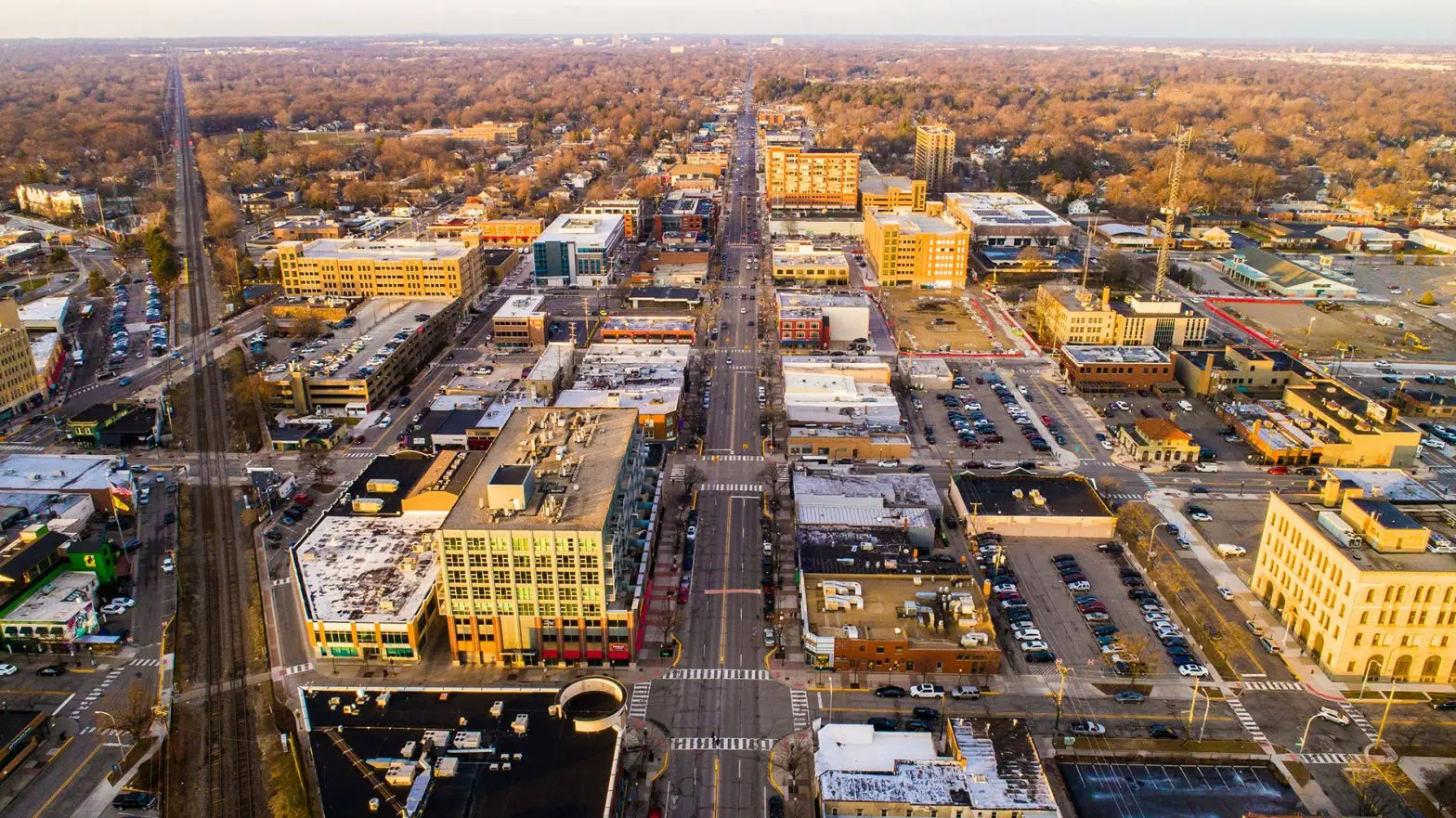
Warren is Michigan's second-largest city by population and one of Macomb County's core industrial and defense-adjacent submarkets, centered on the General Motors Technical Center campus and the U.S. Army's TACOM and Detroit Arsenal presence. Manufacturing and supplier industrial along Van Dyke Avenue and the Mound Road corridor make up the bulk of commercial real estate here.
GM Tech Center and Defense-Adjacent Industrial
The GM Technical Center campus anchors a cluster of engineering, R&D, and supplier office space that behaves more like specialized flex product than conventional suburban office, since much of it was purpose-built for automotive engineering work. Nearby, TACOM and Detroit Arsenal support defense-contractor tenants whose lease structures and security requirements differ from a typical industrial lessee.
An exchanger evaluating a defense-adjacent building should expect longer lease terms and more government-contract-linked tenant stability than in conventional industrial space, but also more restrictive re-leasing conditions if that specific tenant relationship ends.
Van Dyke Avenue and 12 Mile Manufacturing Base
Van Dyke Avenue carries one of the densest concentrations of manufacturing and supplier industrial buildings in Macomb County, much of it built decades ago for auto-parts production and varying widely in ceiling height, floor load, and dock configuration. The 12 Mile and Mound Road area adds a mix of newer flex and warehouse product alongside the older stock.
Because so much of Warren's industrial base ties back to automotive supply chains, tenant-concentration risk runs high in this submarket, and an exchanger should treat a single-tenant supplier building differently in underwriting than a multi-tenant logistics building nearby.
Property Types Tied to Warren's Industrial Base
A Warren identification list typically draws from:
- Auto-supplier industrial along Van Dyke Avenue
- Engineering and R&D flex space near the GM Tech Center
- Defense-contractor buildings near TACOM and Detroit Arsenal
- Newer warehouse and logistics product near Mound Road
- Retail and multifamily serving the city's workforce base
Underwriting Government-Contractor-Adjacent Real Estate
Lenders underwriting a defense-contractor-leased building will look closely at the tenant's contract relationship with the federal government, since a contractor's lease renewal often tracks its own contract award cycle rather than a standard commercial lease timeline, which can mean either unusual stability or unusual risk depending on where that contractor sits in its award cycle.
For conventional auto-supplier industrial, the underwriting question is similar but tied to the automaker's production contracts instead of a federal one — either way, an exchanger should get the actual tenant contract terms rather than relying on the lease alone to judge renewal likelihood.
Backup Market Logic for a Macomb Manufacturing Exchange
Given how concentrated Warren's industrial base is in automotive and defense tenants, exchangers often diversify a Macomb County identification list by pairing a Warren candidate with a Sterling Heights or Taylor property serving a different tenant base, spreading concentration risk across the three-property list rather than doubling down on one supply chain. That spread matters most when the Warren candidate's lease is tied to a single supplier contract with no other tenants to fall back on.
For workforce-serving retail and multifamily, Warren candidates hold up as a standalone target since that demand is tied to the city's overall population rather than to any single employer, and turnover in that segment has been steady enough to support a normal identification timeline.
Common 1031 Exchange Questions
How does tenant concentration in defense-contractor or auto-supplier buildings affect the boot calculation?
Boot is a function of the exchange's value and debt structure, not tenant type, so tenant concentration itself doesn't directly create boot. It can indirectly affect boot exposure if a lender offers less financing on a building it views as higher-risk due to tenant concentration, which then creates a debt shortfall relative to the relinquished property.
Can a Warren building leased to a federal defense contractor still qualify for like-kind treatment?
Yes, the tenant's identity and the nature of its lease with the federal government don't affect like-kind qualification — what matters is that the property itself is real property held for investment or business use, which a leased industrial or office building satisfies regardless of who the tenant is or what agency it serves.
Is Warren's industrial stock deep enough to fill a full three-property identification list on its own?
Warren has significant industrial turnover given its size, but because so much of it ties to a small number of large employers, most exchangers still diversify by naming a Sterling Heights or Taylor property alongside a Warren candidate to avoid having the entire identification list depend on one or two tenant relationships.
What should you ask a defense-contractor tenant for during due diligence that you wouldn't ask a standard tenant?
Beyond a standard estoppel certificate, it's worth understanding where the tenant sits in its current contract cycle with the federal government, since a lease that looks secure on paper can carry more renewal uncertainty if the underlying government contract is nearing its own end date than the lease term alone would suggest.
How does the qualified intermediary's role change for a government-contractor-leased property?
It doesn't change — the qualified intermediary holds proceeds and manages exchange documentation regardless of the tenant's identity or contract relationships. Reviewing the tenant's government contract standing is a due diligence matter for the exchanger, separate from the intermediary's role, and typically involves the exchanger's own broker or attorney rather than the intermediary directly, since that review falls outside the intermediary's narrow exchange function entirely.